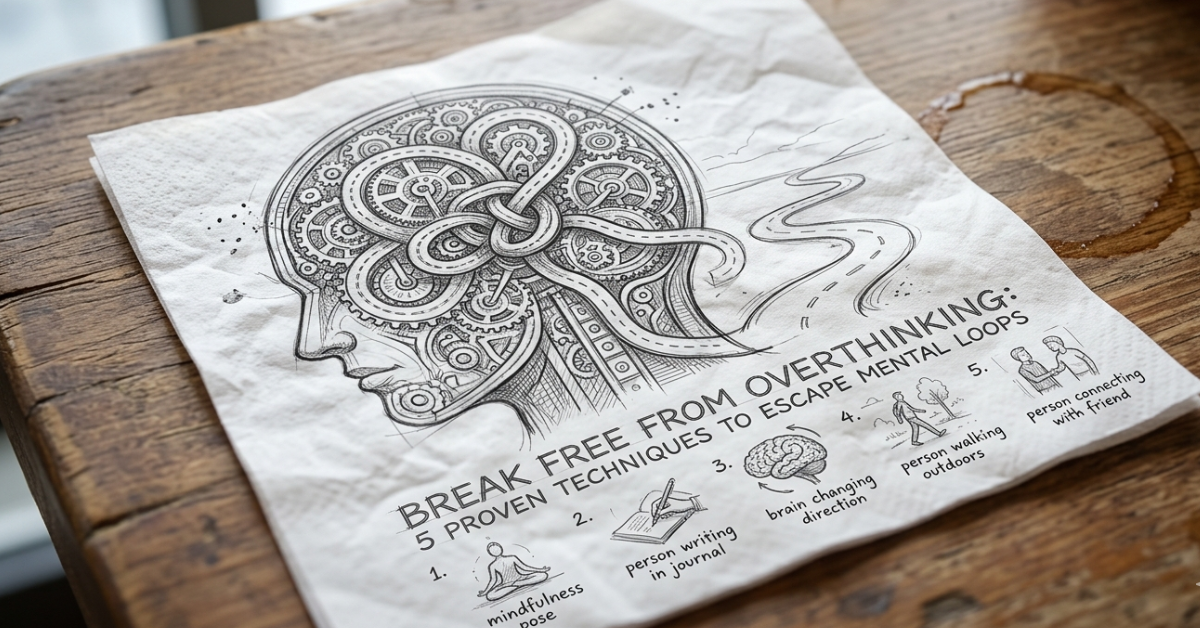
Conquer Overthinking: 5 Proven Techniques to Escape Mental Loops
Rate the Show here -> https://ratethispodcast.com/mentalhealthtodayshow
Introduction
If you’ve ever found yourself replaying the same worry over and over, analyzing every possible outcome until you’re mentally exhausted, you’re not alone. Overthinking affects millions of high-achieving professionals who struggle with persistent mental loops that seem impossible to escape.
As a Licensed Professional Counselor and founder of MyndStill, I’ve worked with countless individuals who’ve mastered their careers but feel defeated by their own minds. Today, we’re diving deep into the mechanics of overthinking and exploring five evidence-based techniques that can help you break free from these destructive patterns.
Topics Covered
Understanding the Overthinking Trap
- The neurological basis of rumination and why our brains get stuck
- How overthinking differs from productive problem-solving
- The connection between perfectionism and mental loops
- Why high achievers are particularly vulnerable to overthinking patterns
The Five Proven Techniques
1. The 5-4-3-2-1 Grounding Method
- Engaging your senses to interrupt rumination
- Step-by-step implementation guide
- When and where to use this technique most effectively
2. Cognitive Restructuring for Thought Loops
- Identifying cognitive distortions that fuel overthinking
- The ABCDE model for challenging negative thoughts
- Practical examples of reframing common worry patterns
3. Time-Boxing Your Worry
- Setting designated “worry time” to contain anxious thoughts
- How to postpone rumination without suppression
- Creating boundaries between productive concern and destructive overthinking
4. The Mental Reset Technique
- Using physical movement to break mental patterns
- Breathing exercises that calm the nervous system
- Quick reset strategies for the workplace
5. Values-Based Decision Making
- Aligning choices with core values to reduce second-guessing
- Creating decision frameworks that minimize regret
- Moving from analysis paralysis to confident action
Key Insights
“Overthinking isn’t a character flaw—it’s a learned pattern that can be unlearned with the right tools and consistent practice.”
“The goal isn’t to eliminate all worry, but to transform unproductive rumination into purposeful problem-solving.”
“When we align our decisions with our values rather than our fears, we naturally reduce the mental noise that feeds overthinking loops.”
Action Steps for Implementation
- Start Small: Choose one technique and practice it consistently for one week
- Track Your Progress: Notice when overthinking begins and which technique works best
- Create Environmental Cues: Set phone reminders or visual triggers to prompt technique use
- Practice Self-Compassion: Remember that breaking mental habits takes time and patience
Resources for Continued Growth
Ready to take your mental wellness journey further?
- Subscribe to The Mental Freedom Newsletter for weekly tips on quieting overthinking: johncordray.me/subscribe
- Download the MyndStill App for guided mental wellness exercises
- Connect on Social Media: Follow @JohnCordrayLPC on X and LinkedIn for daily insights
Final Thoughts
Breaking free from overthinking loops isn’t about perfection—it’s about progress. Each time you catch yourself ruminating and apply one of these techniques, you’re rewiring your brain for greater mental freedom. Remember, the most successful professionals aren’t those who never experience anxiety or overthinking; they’re the ones who have developed effective tools to manage these challenges.
The journey to mental clarity is ongoing, and every small step counts. Start with one technique today, and give yourself credit for taking action toward a calmer, more focused mind.
This episode provides informational support only and is not a substitute for professional therapy. If you’re experiencing persistent anxiety or mental health concerns, please consult with a qualified mental health professional.
Ready to dive deeper? Listen to the full episode for detailed explanations, real-world examples, and additional strategies for managing overthinking and anxiety.
If you’re a high-achieving professional, chances are you’re intimately familiar with the exhausting cycle of overthinking. You know the feeling—your mind latches onto a problem, concern, or situation and simply won’t let go. What starts as productive problem-solving quickly spirals into an endless loop of “what-ifs,” worst-case scenarios, and circular thoughts that leave you feeling mentally drained and more anxious than when you started.
As a Licensed Professional Counselor who works extensively with busy professionals and high-achievers, I’ve witnessed firsthand how overthinking can become a significant barrier to mental wellness. The irony is that the very cognitive abilities that make you successful in your career—analytical thinking, attention to detail, and thorough planning—can sometimes work against you when they become excessive and uncontrolled.
Understanding the Overthinking Trap
Before we dive into the solutions, it’s crucial to understand what’s happening in your brain when you get caught in these mental loops. Overthinking isn’t just a bad habit—it’s often your mind’s misguided attempt to solve problems and maintain control. Your brain believes that if it can just think through every possible scenario, it can prevent negative outcomes and ensure success.
However, this mental strategy backfires spectacularly. Instead of providing clarity and solutions, overthinking typically leads to:
- Increased anxiety and stress
- Decision paralysis
- Mental exhaustion
- Decreased productivity
- Strained relationships
- Physical symptoms like headaches and sleep disruption
The key insight here is recognizing that overthinking is fundamentally different from productive problem-solving. Productive thinking moves you forward toward solutions, while overthinking keeps you stuck in repetitive cycles that generate more questions than answers.
Five Proven Techniques to Break Free
1. The Two-Minute Rule
One of the most effective ways to interrupt overthinking is to implement a strict time boundary. When you notice your mind beginning to loop on a particular issue, set a timer for two minutes. During this time, allow yourself to think about the problem, but when the timer goes off, you must consciously redirect your attention elsewhere.
This technique works because it acknowledges your brain’s need to process while preventing the endless spiral. Most genuine insights occur within the first few minutes of focused thinking—everything after that is typically unproductive rumination.
2. The Physical Redirect
Overthinking is largely a mental phenomenon, which means engaging your body can be incredibly effective at breaking the cycle. When you catch yourself in a mental loop, immediately engage in physical activity. This could be:
- Taking a brisk 5-minute walk
- Doing jumping jacks or push-ups
- Engaging in deep breathing exercises
- Progressive muscle relaxation
Physical activity shifts your nervous system out of the anxious, overthinking state and into a more grounded, present-moment awareness. The key is to make the physical redirect immediate—don’t wait for a “better time” to implement it.
3. The Worry Window Technique
Rather than trying to eliminate worrying thoughts entirely (which often backfires), schedule a specific “worry window” each day. This might be 15-20 minutes where you allow yourself to fully engage with your concerns. Write them down, think through potential solutions, and give your anxious thoughts the attention they’re demanding.
Outside of this designated time, when overthinking thoughts arise, remind yourself: “I’ll address this during my worry window.” This technique satisfies your brain’s need to process concerns while containing the overthinking to a manageable timeframe.
4. The Evidence-Based Challenge
Overthinking often involves catastrophic thinking and jumping to worst-case conclusions. Combat this by becoming a detective of your own thoughts. When you notice yourself spiraling, ask:
- What evidence do I have that this worst-case scenario will actually happen?
- What evidence contradicts this fear?
- What would I tell a friend who came to me with this same concern?
- What’s the most likely outcome based on past experience?
This technique helps you move from emotional reasoning to logical evaluation, breaking the cycle of anxiety-driven overthinking.
5. The Present-Moment Anchor
Overthinking almost always involves mental time travel—either rehashing the past or catastrophizing about the future. Grounding yourself in the present moment is a powerful antidote. Use the 5-4-3-2-1 technique:
- 5 things you can see
- 4 things you can touch
- 3 things you can hear
- 2 things you can smell
- 1 thing you can taste
This sensory grounding exercise immediately brings your awareness back to the here and now, interrupting the mental loops that exist only in your thoughts about past or future scenarios.
Implementation Strategy
The key to success with these techniques isn’t perfection—it’s consistency. Start by choosing one or two methods that resonate most with you and practice them regularly. Remember that breaking longstanding overthinking patterns takes time and patience with yourself.
It’s also important to recognize when overthinking might be a symptom of underlying anxiety or other mental health concerns that could benefit from professional support. These techniques are powerful tools for managing everyday overthinking, but they’re not a substitute for professional therapy when deeper intervention is needed.
Your Path to Mental Freedom
Breaking free from overthinking loops isn’t about eliminating all worry or concern from your life—it’s about developing a healthier relationship with your thoughts. You can maintain your high standards and analytical abilities while protecting yourself from the mental exhaustion that comes with excessive rumination.
The goal is to become the observer of your thoughts rather than being completely consumed by them. With practice, you’ll develop the ability to notice when your mind is beginning to loop and have effective tools to redirect your mental energy toward more productive pursuits.
Ready to dive deeper into these overthinking management techniques and discover additional strategies for mental wellness? Listen to the full episode of “Overthinking Loops and Anxiety Management Techniques” on the Mental Health Today Show. You’ll get detailed guidance on implementing these methods and hear real-world examples of how they’ve helped other high-achievers reclaim their mental freedom.
Key Take-A-Ways:
Overthinking doesn’t discriminate—it affects high achievers and busy professionals just as much as anyone else. In this essential episode, we dive deep into practical, proven techniques for breaking free from those exhausting mental loops.
1. Recognize the Loop Before It Takes Control
The first step to breaking overthinking patterns is developing awareness of when they begin. Most people don’t realize they’re caught in a mental loop until they’ve been spinning for hours or even days.
2. Use the “5-4-3-2-1” Grounding Technique
This sensory-based method interrupts overthinking by redirecting your attention to the present moment. Identify 5 things you can see, 4 you can touch, 3 you can hear, 2 you can smell, and 1 you can taste.
3. Set Designated “Worry Time”
Instead of letting anxious thoughts consume your entire day, schedule 15-20 minutes of dedicated worry time. When overthinking starts outside this window, remind yourself to save it for your designated time slot.
4. Challenge Catastrophic Thinking with Evidence
High achievers often fall into the trap of imagining worst-case scenarios. Combat this by asking yourself: “What evidence do I have that this will actually happen?” and “What would I tell a friend in this situation?”
5. Practice the “Mental Stop Sign” Technique
When you notice overthinking beginning, visualize a bright red stop sign and say “STOP” either out loud or in your mind. This interruption creates space for you to choose a different mental direction.
6. Implement the “Two-Minute Rule”
If a worry or concern can be addressed in two minutes or less, do it immediately. If it requires more time, either schedule it for later or add it to your designated worry time.
7. Use Physical Movement to Break Mental Patterns
Overthinking creates physical tension that reinforces mental loops. Simple activities like walking, stretching, or even changing your physical position can help interrupt these patterns.
These techniques work best when practiced consistently, not just during moments of intense anxiety. Listen to the full episode to hear detailed examples and learn how to customize these strategies for your specific overthinking patterns and lifestyle demands.

Subscribe to The Mental Freedom newsletter for weekly tips to quiet overthinking and reclaim mental clarity: https://johncordray.me/subscribe
Remember: This content provides informational support only and is not a substitute for professional therapy.